



Downloadable Files:
Text:
God’s Family
Lesson 2: Members Of One Another
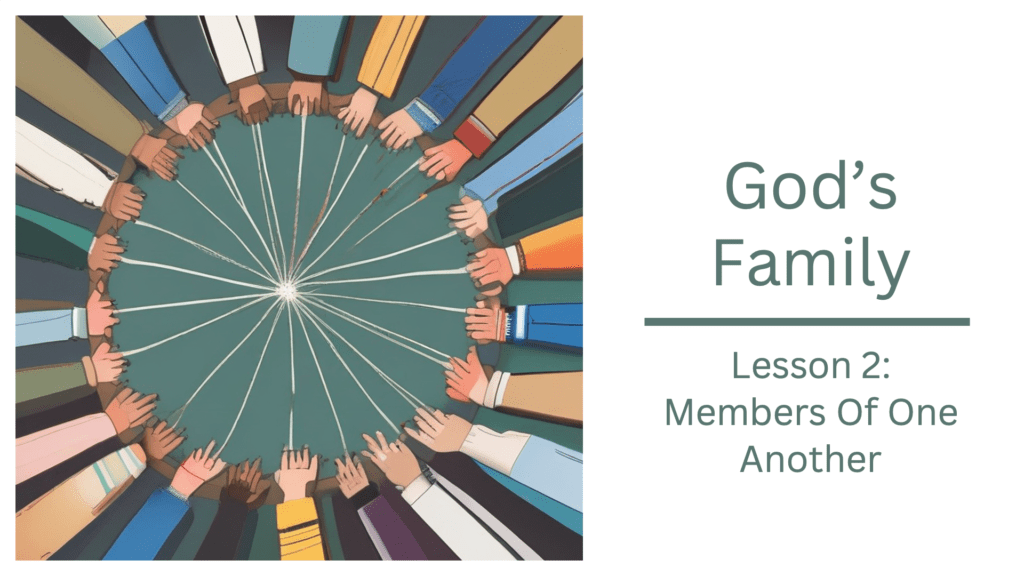
God has given His people a spiritual family. However, the family God has designed for His people is not intended to consist of people who are faintly acquainted with one another. Instead, God has blessed every Christian to be part of a family in which He intends for every member to be interconnected with the others – like a cord of many strands is woven together.
Romans 12:3-8
It can be tempting for Christians to think of themselves only as members of Christ who attend church services with other Christians. These become consumers of what a church produces and have little/no interaction with the others who attend between the services (e.g. those who attend a club). However, this passage demonstrates that true Christians are both members of the body of Christ (His church) and members of one another (the other members of the body). This helps take church from being a “box” that gets checked to something far more! In particular, these Christians view themselves as interdependent with one another. So, you cannot simply have a consumeristic mindset of the church; but must contribute your share to helping the body of Christ (both helping the whole body and helping each member).
1 Corinthians 12:12-27
Although there is an aspect of each Christian working out his/her salvation (Philippians 2:12), there is also a clear expectation that God wants each Christian to be concerned about the function of the entire body of Christ. Losing this perspective can lead to shaming members who are perceived as being “lesser” in ability or importance and causing division. However, recognizing your interdependence will help you recognize that both you and the body are better whenever every member is as strong as possible (like your body is better whenever each member is as strong and healthy as possible). This perspective recognizes that there are things you can offer that others cannot and things that they can offer that you cannot (e.g. experiences, abilities, knowledge, resources, relationships, etc.). Therefore, rather than viewing other Christians through a lens of competition, rivalry, irrelevance, etc., you should have great care for each member of God’s body/family and do and give what you can to help other members be stronger. Like a team, together everyone achieves more (TEAM)! You should be so interconnected with your brothers and sisters that you are affected (e.g. emotionally) by the things that happen in their lives (good and bad).
Ephesians 4:25
The perspective of being members of one another changes how you view other Christians. This passage further demonstrates that being members of one another also impacts how you treat other Christians. For example, Christians must not lie to one another because we are members of one another. That is, we don’t just stay away from lying because God has commanded us not to lie and wants us to speak the truth. We also stay away from lying and speak the truth because we are interconnected with one another. So, we don’t want to mislead anyone we care so deeply about. And, we only want those who will impact our lives believing and acting according to the truth. Consider: If I have sin in my life that I lie to my brother or sister about, how will they be able to help me live pleasing to God? They cannot.
Acts 2:42-47
As this was the day Jesus’s church began, there were now only about 3,000 people who had submitted their lives to King Jesus in the entire world (vv. 37-41). Notice, among other things, their interdependence. Nobody else in the world could help them accomplish what was now most important in their lives. Nobody else in the world even understood. They spent time with each other (both in large gatherings of the church and small gatherings in each other’s homes). They took care of one another (both physically and spiritually). Today, while there are Christians throughout the world, your participation in a local church should recognize that the other members of that church are the people who best can understand, relate to, and help you in your community – and you for them. Due to this, Christians must spend time together (both inside and outside of the church assemblies). For, you cannot live as a member of your brothers and sisters in Christ if you do not spend time with and around them! To do this, though, will require sacrifice (e.g. time, money, personal ambitions, hobbies, recreational activities, etc.).
Acts 9:26-28
Paul joined himself to the disciples in Jerusalem when he came to Jerusalem and became involved with them (coming and going with them). This is the concept of a “local” church, as it is important for the members of the church (as much as possible) to be in/near the same community. If not, it will be difficult for the members to be genuinely part of one another’s lives (e.g. due to physical distance). Sadly, joining a church is often viewed primarily from a selfish (consumeristic) perspective that seeks to find a church that suits the individual (e.g. what the church offers you). Yet, God’s perspective of the local church is a local family of His people who are deeply intertwined and involved in one another’s lives as they seek to serve Him – both through the collective church activities and outside of these activities!
Conclusion
As a Christian, you are a member of your brothers and sisters. You must not consider yourself as separate and independent from others who have true faith in Jesus. Instead, you must view yourself as one who is deeply involved in the lives of your brothers and sisters, both giving and receiving all the responsibilities and blessings that are involved in this interdependent relationship God has designed!
Discipleship Questions
How can many people have a consumeristic mentality of the church?
How does viewing yourself as a member of your Christian brothers and sisters help correct this consumeristic mentality?
What concern should you have for the entire body of Christ?
How interconnected should you be with other Christians?
How does viewing yourself as a member of your Christian brothers and sisters impact how you treat them?
How were the relationships between Christians deeply valued in the early church?
What did early Christians do with and for one another?
How should Christians live as members of one another in the specific context of the local church?