



Downloadable Files:
Text:
That You May Know The Certainty
Lesson 16: Jesus’s Journey To Jerusalem, Part 6 (Luke 15:1-16:13)
After teaching in the house of a leading Pharisee (Luke 14:1), Jesus left and great crowds followed (14:25). Jesus taught them concerning the cost of being His disciple (14:25-35). Now, Jesus’s teaching shifts to answer some criticism about who was with Him.
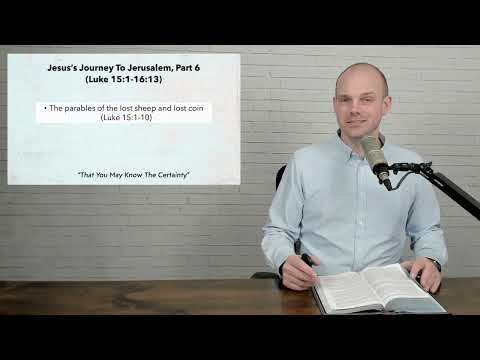
The Parables Of The Lost Sheep And Lost Coin (Luke 15:1-10)
15:1-2. Tax collectors and sinners were coming to listen to Jesus and Jesus welcomed and ate with them (Luke 5:27-32). The Pharisees and scribes looked down on these while considering themselves righteous (Luke 18:9-14). They complained about Jesus keeping company with such people.
15:3-10. Jesus told three parables in response to the situation. In the first parable, one out of one hundred sheep became lost; yet the shepherd left the 99 (who were in no danger) to go and search for the lost one until he found it (Matthew 9:36). When he found it, he carried it home on his shoulders and rejoiced with others. In the second parable, a woman lost one out of ten silver coins (drachma; equivalent to a Roman denarius, or a common day’s wage). This one did everything necessary (lit a lamp, swept the house) and searched carefully until she found it. When she found it, she rejoiced with her friends and neighbors. Both parables present God as One who seeks the lost and rejoices (along with His angels) when the lost one is found. This should have explained why Jesus was concerned for sinners to spend time with them.
The Parable Of The Lost Son (Luke 15:11-32)
15:11-24. This third parable continues to relate to the complaint about Jesus welcoming and eating with sinners (vv. 1-2) but is developed more than the first two (which demonstrated Jesus’s concern for the lost). In it, the younger of two sons demanded his share of the inheritance he was set to receive early so he could go away to live without his father’s oversight and control. After receiving his inheritance (one-third of the total inheritance, Deuteronomy 21:17), he traveled to a distant country and wasted his inheritance in foolish (reckless, wasteful, prodigal) living (thought by his brother to include prostitutes, v. 30). However, he reached a point at which he had spent everything and had nothing. Then a famine hit and he found himself in such great destitution that he tried to go to work for a pig farmer (note that pigs were unclean to Jews, Leviticus 11:7) and would have gladly eaten the pig food but was not given enough food to satisfy. At this point, he came to his senses and recognized that even his father’s hired workers were in a better situation than him and he determined to go to his father, repenting of his sin against Heaven and his father, asking to be made like one of the hired workers. Then, after preparing himself, he went to his father and did what he had determined to do. Notice the father’s response to seeing his son return was compassion, love, and acceptance – including the acceptance of him as his son (indicated by the gifts and reception). He celebrated the return of his son with a feast because his son who was as if he had been dead and lost was now alive and found – and all the people celebrated with him. Similar to the previous parables, this demonstrates the destitution of sin and the sorrow one should experience over sin. Then, it demonstrates God’s concern (representative of the father) for the lost and, therefore, the reason Jesus got involved with sinners.
15:25-32. The next piece of the parable now focuses on the response of the father’s older son (who had never left). He heard the music and dancing and inquired what was happening. When he was told about the celebration because of his brother’s return and his father’s reception of his brother, he was angry and did not want to go into the feast. His father came to plead with him to join them and be joyful over his brother’s return. However, this son was self-righteous and did not approve of the reception of the younger son (who he said wasted the father’s assets with prostitutes), complaining that such a feast had not been given for him. To this, the father simply replied that the older son had access to all he had, but it was right to celebrate and rejoice over the younger son (who was now alive and found)! This part of the parable is apparently directed at the Pharisees and scribes for their self-righteous attitude toward the sinners Jesus was with (like the older son). However, notice the father’s concern for both of his sons, neither of whom was living how they should (one immoral and one self-righteous), just like God is concerned for all people (e.g. the sinners and the Pharisees). Jesus, therefore, demonstrated it was right for him to be with sinners so they could be saved!
The Parable Of The Dishonest Manager (Luke 16:1-13)
16:1-8. Jesus teaches another parable apparently in the same setting as the previous ones, albeit directed toward His disciples (though others also heard, Luke 16:14). In it, a rich man received an accusation against his manager in charge of his business dealings that the manager was wasting his possessions. So, he had to give a report of his management and the master determined the manager would no longer hold his position. The manager determined he was not strong enough to be employed through hard labor (dig) and was too ashamed to beg to get what he needed for survival. So, he shrewdly and dishonestly went to work gaining favor with other people so they would welcome him into their homes. Before he was fired, he slashed the debt people owed his master. The master praised this unrighteous (dishonest) manager for his shrewdness in thinking ahead (not justifying his unrighteousness). Then, Jesus teaches the point of the parable to be that children of the world (focused on the world) often demonstrate more foresight and zeal in their dealings for things that do not last than children of light (focused on righteousness) do for the things that last.
16:9-13. Jesus applies this parable to instruct that His disciples should use unrighteous money (i.e. worldly wealth) to do good for God’s kingdom (1 Timothy 6:17-19). Then, when the money fails (and it will fail; Matthew 6:19-21), there will be an eternal dwelling waiting in Heaven! Whether you have been blessed with a little or a lot of physical wealth, you must be faithful (trustworthy and dependable) to God in using it in the way that pleases Him if you want to receive His blessings. Therefore, you must possess foresight and shrewdness in how you manage what God has blessed you with – as much as worldly people demonstrate over temporary things. Ultimately, you must determine whether you are truly devoted to Him as your Master or not since you cannot be devoted to two different masters at the same time (including the master of money, Matthew 6:24)!
Conclusion
Jesus has confronted the Pharisees for the way they had criticized Him in welcoming and eating with sinners. He demonstrated God’s love for people and His desire for all to be saved. Furthermore, He has demonstrated that people ought to be shrewd and not trust in worldly possessions.