



Downloadable Files:
Text:
The Big Picture Of The Bible Story
Part 4: The United Kingdom
God had fulfilled two of His promises to Abraham by making his descendants into a great nation and giving that nation the land of Canaan. Sadly, after Joshua’s death, the Israelite people (who had made the covenant to be Jehovah’s special people) often rebelled against Jehovah, and even went after other gods. This resulted in the nation of Israel not being blessed by Jehovah in all the ways He desired to bless them. In particular, they failed to drive out all the inhabitants of the land. These inhabitants would then cause regular problems for Israel, despite Israel occupying the land. Samuel was essentially the last of Israel’s judges, one of the great prophets in the Bible, and a key transitional figure. Now, we focus on the fourth major section of the Bible story: “The United Kingdom.”
1 Samuel 8:1-9, 19-22
After leading Israel for many years (1 Samuel 7:15-17), Samuel appointed his sons as judges. However, they were corrupt, and Israel did not accept them. Instead, they demanded that a king be appointed for them so they could be like the other nations. As Samuel considered their demand wrong and prayed to God, God told him to let Israel have a king – with two noteworthy caveats. First, God saw their request as further evidence that they rejected Him as their King. Second, God wanted Samuel to warn them about what having a king would require of them. Samuel then warned the people of many obligations involved in having a king, including how they would even cry out to God because of their king (vv. 10-18). Still, the people demanded a king, and this king would soon be appointed. Please note that God had foretold this and had given specific rules they and the king should follow (Deuteronomy 7:14-20).
1 Samuel 10:17-25
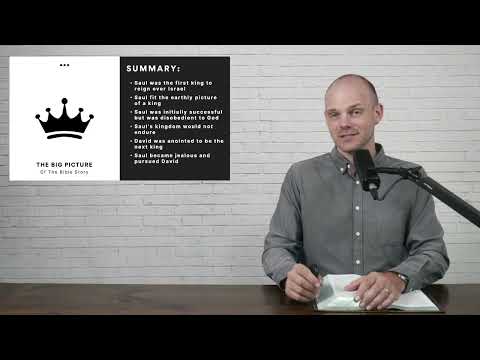
The first king who would reign over the entire nation of Israel was Saul (from the tribe of Benjamin; 1 Samuel 9:1-10:16). Saul fit the earthly picture of a king (1 Samuel 9:2). Although God gave Saul everything he needed to be successful as king (1 Samuel 10:9-11) and had success initially (1 Samuel 11:1-11), Saul was disobedient to God (1 Samuel 13; 15). Therefore, instead of the kingdom being established through Saul’s descendants, it would not endure (1 Samuel 13:13-14; 15:26-29). In fact, God would give the kingdom to one who would be a man after His own heart (1 Samuel 13:13-14). Thus, David (from the tribe of Judah) was anointed as the next in line to be king (1 Samuel 16:1-13), as David demonstrated a heart that trusted in God (1 Samuel 17). God made David successful, and Saul became jealous (1 Samuel 18:1-9), often pursuing and attempting to kill David (1 Samuel 18-31).
2 Samuel 5:1-10
After Saul’s death, Israel eventually united around God’s choice as king – David. After all, David had already emerged as the one who would lead Israel into battle and experienced great successes during the reign of Saul (e.g., 1 Samuel 17). This passage also demonstrates how David was the one who led troops into Jerusalem to capture the city from the Jebusites (Judges 1:21) and took up residence there. Soon afterward, David had the ark of the covenant (the central piece of the tabernacle) moved there, and it became the capital of Israel (2 Samuel 6).
2 Samuel 7:8-16
After David had settled in Jerusalem, it was David’s desire to build a house (temple) for God (2 Samuel 7:1-7). God spoke to David through the prophet Nathan and promised that David’s reign would be passed down to his descendants throughout the generations (as God had foretold, Genesis 49:10). This would begin with David’s son (who would build the temple for God). However, God’s promise ultimately focused on David’s kingdom being permanently established! In this and other passages, there is a reference to a future King (known as the Messiah), who would come through the ancestral line of David and rule over God’s people (Isaiah 9:6-7; 11:1-10; Psalm 2; 89:3-4, 19-37; 110). During David’s reign as king, Israel experienced many victories and blessings. However, David’s sin with Bathsheba and Uriah changed the trajectory of his reign in a way that would never fully recover (2 Samuel 11-12).
1 Kings 2:1-4, 10-12
After David, his son Solomon would be firmly established as the third king over Israel. However, Solomon needed to be faithful to God. God did, in fact, bless Solomon greatly. In particular, God blessed Solomon with a wise and understanding heart, as well as with great riches and honor (1 Kings 3:1-15; 10:14-29). Solomon’s wisdom and the greatness of his kingdom became known throughout Israel, and even among other nations (1 Kings 3:16-28; 4:34; 10:1-13).
1 Kings 8:12-21
Although David had desired to build a temple for God in Jerusalem, it was Solomon who actually built it (1 Kings 6-7). The ark of the covenant (with the two stone tablets from Moses inside) had been brought into the temple’s most holy place, and the glory of Jehovah filled the temple (1 Kings 8:1-11). Solomon then dedicated the temple in front of the people and prayed (1 Kings 8:22-66). Solomon building this temple in Jerusalem was the fulfillment of God’s promises concerning such. God’s glory would now dwell with His people from there in the land He gave them.
1 Kings 11:1-13
Despite Solomon’s great wisdom, he allowed his desire for other women to come before his desire for God. God had warned the Israelites not to intermarry with other nations because they worshiped other gods and would turn the hearts of the Israelites away from Him. This is exactly what happened to Solomon when he disobeyed God and attached himself to 1,000 women. Because of Solomon’s disobedience, God would tear the kingdom away from Solomon. Yet, due to God’s promise to David, it would not be torn away from Solomon during his lifetime and would not be torn away entirely. Yet, severe consequences were about to come on Israel.
Conclusion
The people who were supposed to be God’s holy nation had again rejected Jehovah. This time, they had rejected Him by demanding a king to rule over them to be like the other nations rather than be ruled by Jehovah. In this, God warned them about the duties that would be imposed on them for having a king. We have now watched as there were three kings who reigned over a united kingdom of Israel: Saul, David, and Solomon. When these men served God faithfully, things went well for Israel. However, when they did not keep God’s covenant, the entire nation suffered. Now, God had promised that there was an even greater conflict on the horizon that would result in tearing the kingdom.
Discipleship Questions
Why did Israel’s demand for a king displease God?
How well did Saul serve as king?
Why was David chosen to be king after Saul?
How well did David serve as king?
What did God promise concerning David’s throne?
How well did Solomon serve as king?
What was the significance of the temple being built in Jerusalem?
What would happen to the kingdom of Israel after Solomon?